
How can Unified Namespace change maritime
The UNS is becoming the default architecture and design pattern for structuring data producers and consumers within a real-time industrial environment across manufacturing and process industries around the world. In this article we take a drive into how it can apply to maritime and could it be the paradigm shift in how to we capture and connect data in the maritime.
UNS
Mitch Boswell
5 min read
What is a Unified Namespace (UNS)?
Imagine a central nervous system for your vessel, where every piece of information, from engine temperature to job status, is instantly accessible and understandable by all connected systems. That's the essence of a Unified Namespace. It's not a database or a specific software, but rather a real-time data hub, that semantically organises all events.
At its core, the UNS:
Organises data hierarchically: Think of it like a file system, but for operational data. Data points are logically grouped by location (e.g., vessel name, deck, engine room), equipment, and then the specific tag (e.g., temperature, pressure, RPM).
Provides a single source of truth: All systems publish and subscribe to data within this unified structure, eliminating data silos and ensuring everyone is working with the most current information.
Enables real-time bi-directional communication: Using lightweight IIoT protocols, data flows instantaneously across vessel and port networks, enabling immediate response to changing conditions.
Is agnostic to systems and vendors: The UNS acts as a universal translator, allowing diverse hardware and software from different manufacturers to communicate seamlessly.
What’s the current problem?
Traditionally, industrial systems have utilised the ISA-95 pyramid model. A four-layer hierarchical architecture for data transfer up the business stack. This model generally features a digital thread for communication from physical devices (levels 1-2) through control systems and SCADA to enterprise applications (levels 4-5). Whilst it provided a good foundation, it has it’s limitations and is no longer considered sufficient for modern operations. Some of these include:
Poll-Response: Can be resource-intensive as polling wastes bandwidth even if values haven't changed, hinders mass data movement at lower levels and demands significant infrastructure scaling when adding new asset's or tools.
Non real-time: Data loses time sensitivity as it moves up the stack. How can we be sure that what is happening down in the plant room is the current state of events.
Data Assumptions: This method prevents other systems from utilising produced data for further insights.
Expense of Integration: For every point-to-point solution, it takes time and resources Often ROI is only achieved for the high return investments, meaning lower ROI investments are often excluded or shelved due to cost.
Often users find it easier to implement platforms which take care of multiple levels of the stack. While this may sound like a silver bullet to our problems, it’s generally not. No vendor excels at all levels of the stack, meaning we are either constantly fighting our "Platform" to adapt to our needs or completely bypass it altogether. There is a reason Excel is the number one problem solving tool for businesses across the world. It’s the path of least resistance to solving our data problems. By employing a technology centred approach we ensure that we are continually using the best tool for the job, too solve our problems.
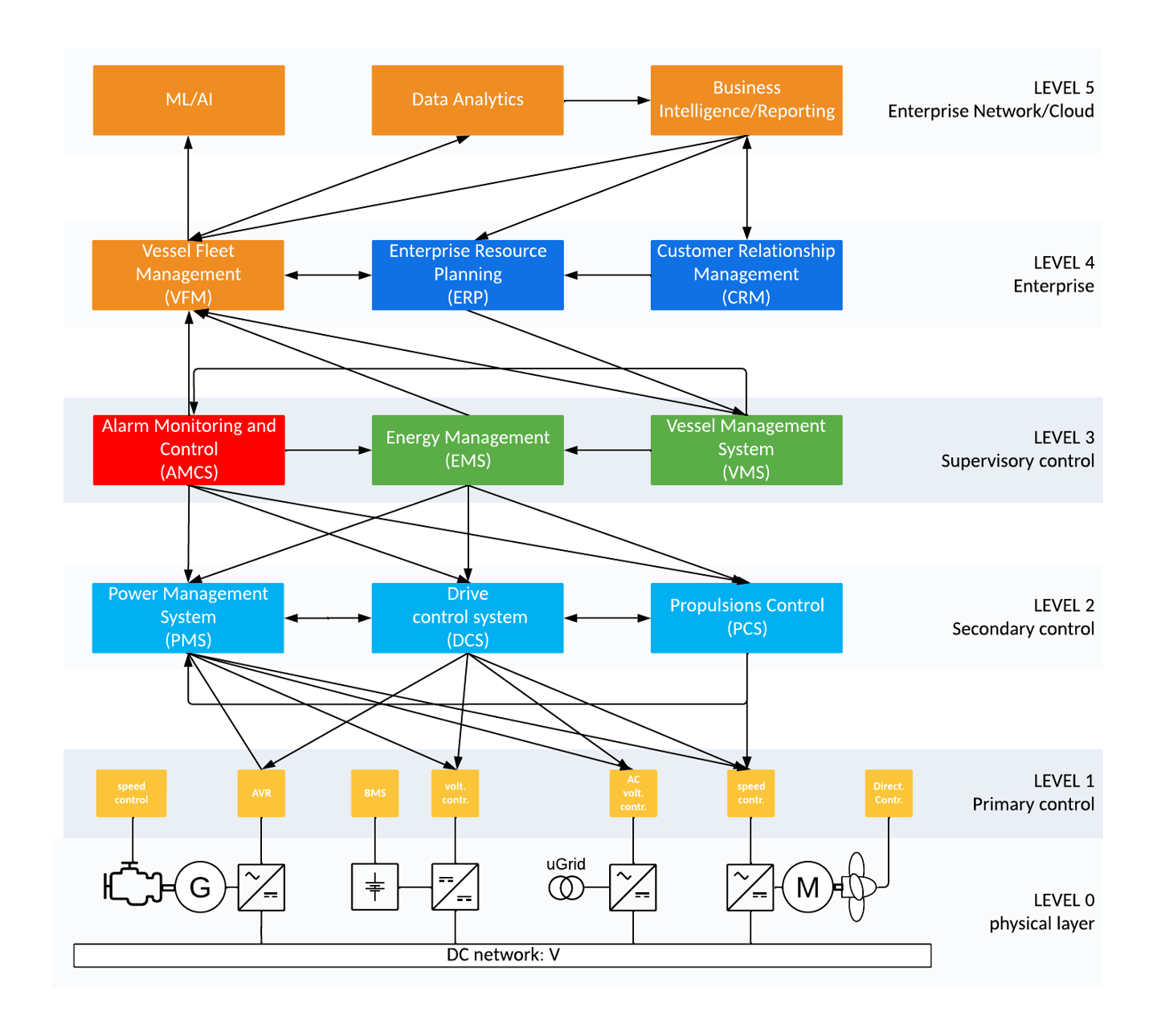
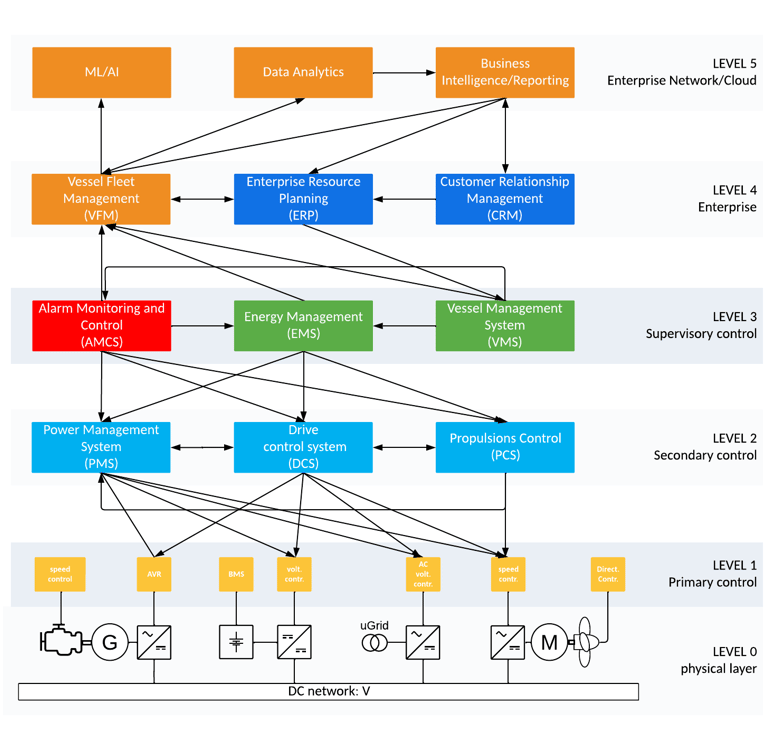
ISA-95 Automation pyramid of a vessel operation
What does this look like?
A UNS attempts to remove point-to-point connections and provide a hub to which all smart things can publish and subscribe. Want to connect a new asset? Simply connect to the UNS and start publishing and instantly data becomes available to all consumers. The structured and standardised nature of the Unified Namespace is particularly advantageous for integrating new vessel assets or software tools. Unlike traditional point-to-point integrations that require custom development for each new device or system, the publish-subscribe model means that any new asset, once configured to communicate and adhere’s to the established hierarchy, can instantly begin publishing its data and consuming relevant information from the namespace. This "plug-and-play" capability dramatically reduces the time, cost, and complexity associated with expanding your network of smart nodes. This allows for selection of the best tool (node) for the job, and avoids vendor lock-in risks.
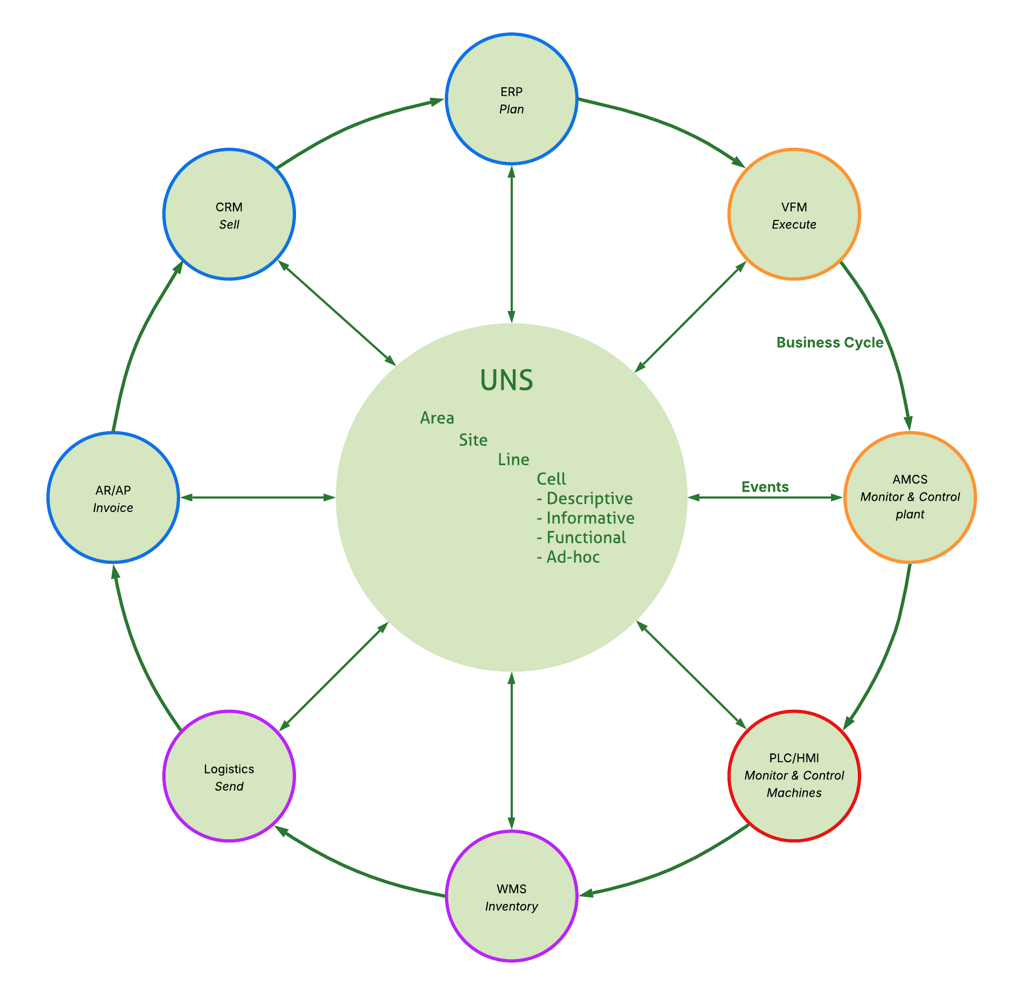
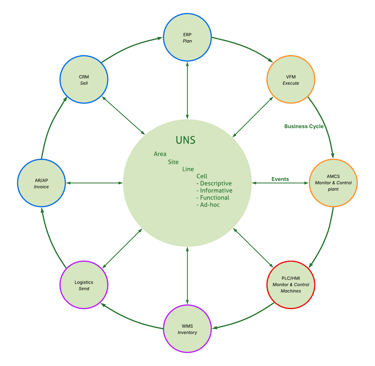
The business cycle of operations with UNS
Why this is crucial for Maritime?
The maritime industry faces unique challenges, from remote operations and harsh environments to complex regulations and the need for optimal efficiency. The Unified Namespace can act as the data foundation to which solutions can be built upon. A hub for all smart things to communicate. Area’s which are becoming more important in maritime and how UNS could help:
Predictive Maintenance: Real-time data from engines, pumps, and other critical equipment allows for predictive maintenance, preventing costly breakdowns and maximising up time.
Optimised Fuel Consumption: By correlating navigation data with engine performance and environmental factors, vessels optimise routes and speeds for fuel savings. This will also be an important factor as emission reporting becomes increasingly mandatory.
Planning Management: Instant access to cargo data, loading progress, current work orders. Port operations are only getting more complex, the need for real time planning optimisation is only getting bigger.
Automated Reporting: Data can be automatically collected and formatted for regulatory compliance, reducing manual effort and potential errors.
Data Ownership: Data flowing through the architecture is owned by your business. Data when transformed into information gives us insight and insight allows us to make decisions. Why give away your most valuable commodity.
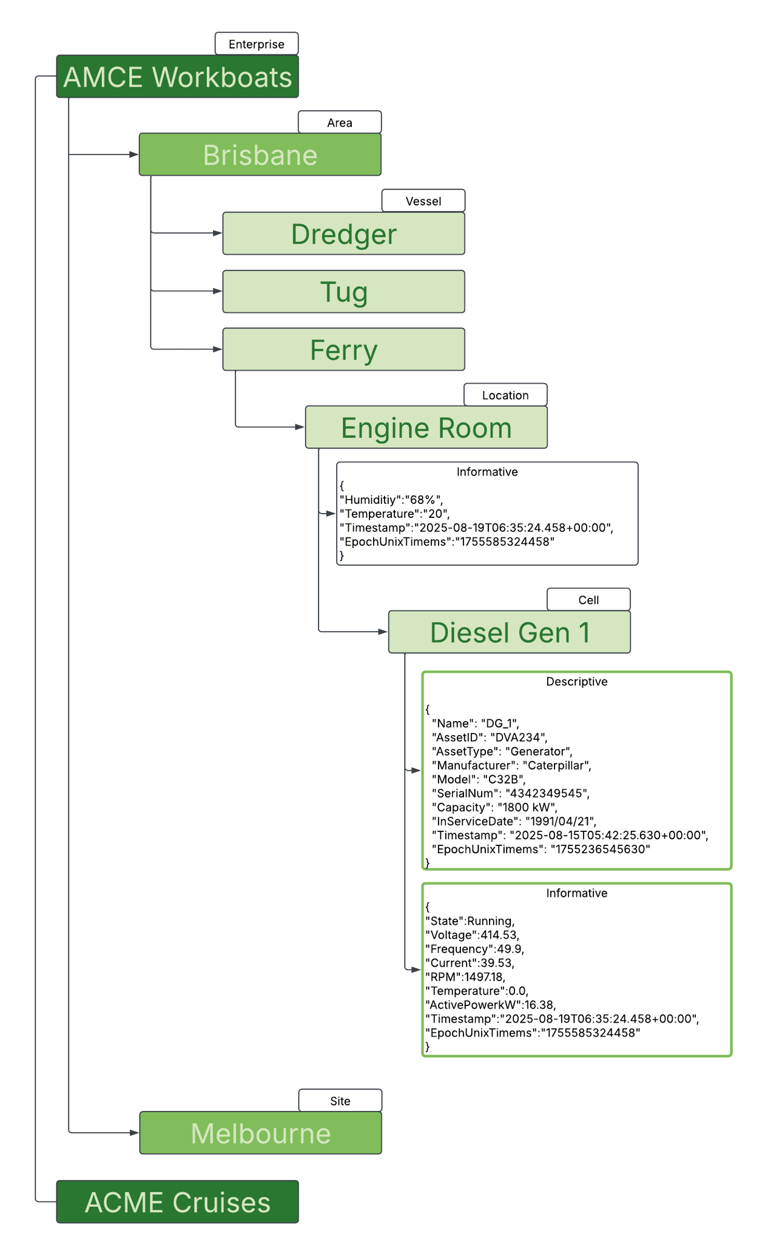
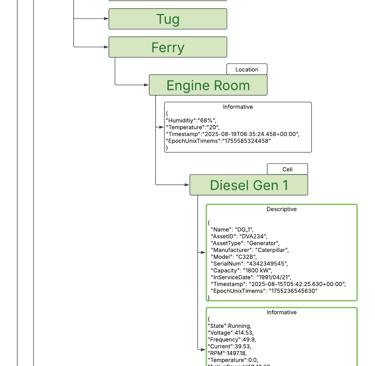
Example hierachy of a vessel fleet
Safety and Security
Real-time Situational Awareness: Whilst AMCS/SCADA performs a critical role in providing users with critical alarms and deterministic control. The underlying operation data is rarely built upon or even hidden. Having a comprehensive, real-time view of all vessel systems and conditions, enables faster and more informed decision-making.
Early Anomaly Detection: Deviations from normal operating parameters can be identified immediately using various machine learning and AI algorithms, allowing for pre-intervention to critical failures. For this we need many tools and access to data.
Enhanced Cyber-security: By utilising broker technology we can ensures that no producer or consumer is ever connected. And connections established from behind the firewall are always outbound connections, meaning we don’t poke holes in security.
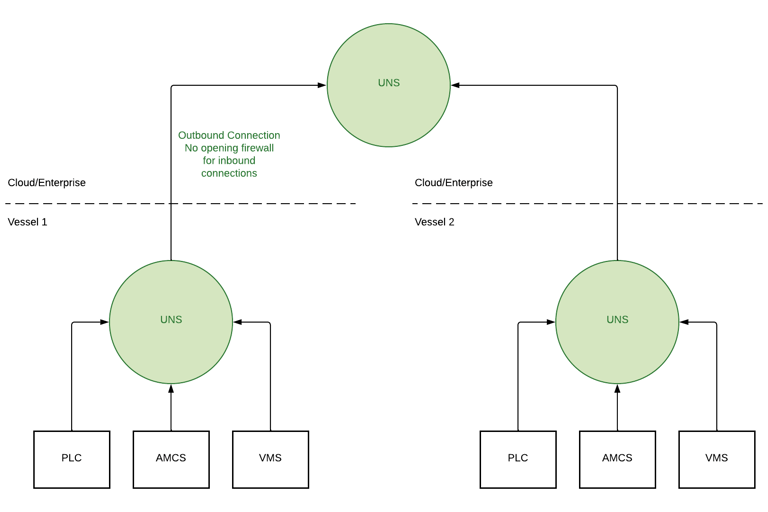
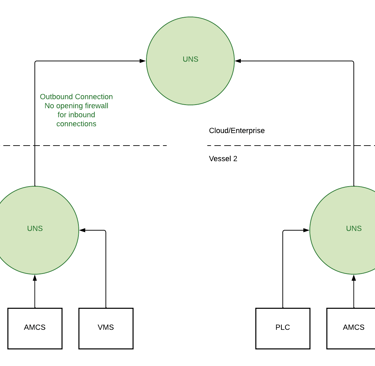
Security by built into ARCHITECTURE
Greater Agility and Scaling
Future-Proofing: The open and flexible nature of a UNS allows for easy integration of new technologies, sensors, and applications as they emerge, without extensive engineering.
Scalability: As vessels become more instrumented, the UNS can easily scale to accommodate increasing volumes of data and connected devices.
Data-Driven Decision Making: With all operational data readily available, vessel operators and onshore teams can leverage analytics and AI to gain deeper insights and optimise performance.
Remote Monitoring and Control: The UNS facilitates secure, real-time data access from shore, enabling remote diagnostics, troubleshooting, and even limited control capabilities.
The Future is connected
The Unified Namespace is not just a technological advancement; it's a paradigm shift for operations. By creating a truly connected and intelligent vessel, we can unlock unprecedented levels of efficiency, safety, and innovation. If we can take advantage of the data vessels produce we can rapidly increase speed towards a smarter more advanced maritime future. No one provider can provide solutions to all your problems, and it would be foolish to think they could. We need an eco-system of tools and it start’s with the foundation.